PEEK machined parts refer to various components or semi-finished products made from polyetheretherketone (PEEK), a high-performance engineering plastic, through specific processes. Due to its excellent high-temperature resistance, high strength, and corrosion resistance, it is often used as a lightweight solution to replace steel with plastic.
The main molding and processing techniques for PEEK machined parts are as follows. Depending on the shape, precision, and production volume requirements of the parts, different methods will be selected
The core challenge of PEEK processing lies in the contradiction between its high temperature and high wear resistance properties, and its poor thermal conductivity and high price.
Moisture is an invisible killer: PEEK must be strictly dried before molding (usually at 150°C for 2-3 hours) to control the moisture content below 0.02%. Otherwise, the surface of the processed parts may exhibit pores, yellowing, or even internal porosity, seriously affecting performance.
Temperature control determines success or failure: whether it’s injection molding, extrusion, or machining, temperature is the core control point. If the temperature is too low, the material will have poor fluidity or difficulty in cutting; if the temperature is too high, PEEK will degrade and carbonize, resulting in black spots and yellowing in the product, leading to scrap.
Internal stress and dimensional stability: PEEK has a high degree of crystallinity, and internal stress tends to accumulate after processing, leading to warping or cracking. It is usually necessary to eliminate the internal stress through annealing treatment (such as slow cooling) to ensure dimensional accuracy. During machining, it is also necessary to consider that its thermal expansion coefficient is 10 times that of metal.
Tool and equipment wear: When processing PEEK, especially grades reinforced with glass fiber or carbon fiber, the wear on tools is significant, necessitating the use of diamond-coated or CVD diamond tools. Injection molding equipment also requires screw and barrel materials that are resistant to high temperatures and corrosion
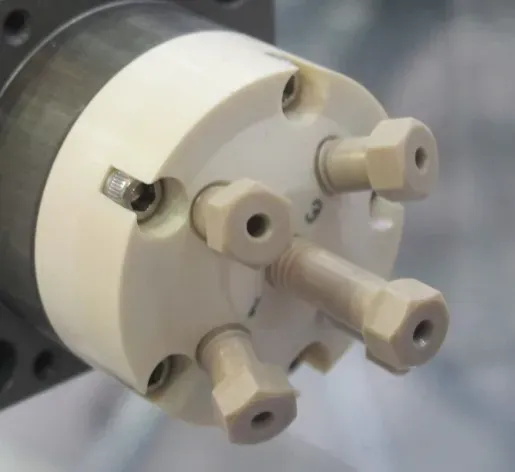
PEEK Processed parts
| Product Parameters | |
|---|---|